
Half a house still travels overseas perfectly well, and it doesn’t need a steel box the size of a garage to get there. Plenty of moves amount to one bedroom, a kitchen and a shed’s worth of tools.
Shared loads solve that, and a small international move is the job Home Port Northwest gets asked about most. You pay for the space your goods fill rather than for the empty air beside them.
This guide covers what counts as a small load and why sharing costs less. It also compares sea and air shipping on price and timing. Let’s get into it.
Small International Move: Why Half a House Doesn’t Need a Full Container When Moving Overseas
Most people planning a move abroad assume a shipping container has to be full to make sense. Carriers sell space by the cubic metre instead. Your part load then sails on the same ship as everyone else’s furniture.
Honestly, a small international move almost never fills a box on its own. The three questions below sort out where yours sits:
Shipment Size: What Counts as Half a House in Overseas Removals Australia-wide
Shipment size is the first thing to pin down. Half a house usually means 15 to 25 cubic metres, about what a one- or two-bedroom home holds. Picture a lounge suite, a queen bed, a dining setting and about 40 cartons.
Most people forget the awkward items as well: bikes, surfboards and the garage shelf nobody sorted (the shed always surprises you). Those add volume fast, so measure before you guess.
In our experience quoting household relocations, a couple leaving a rented unit lands near 18 cubic metres. Families with a full garage roughly double that figure.
How Many Shared Containers Do Smaller Loads Need?
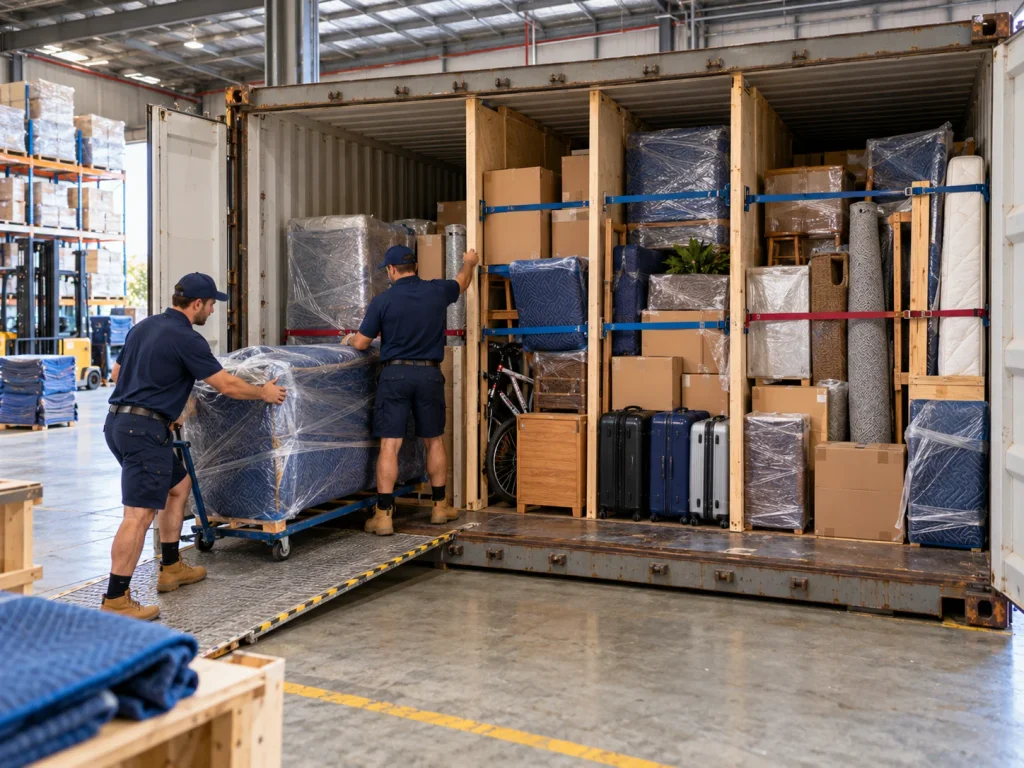
None of your own. Your goods travel in a container shared with several other households, and that box is either 20ft or 40ft.
A 20ft container holds four or five part loads, while 40ft containers take closer to eight. It depends on how tightly the crew packs each one. That’s why the answer comes in cubic metres rather than whole boxes. Your 18 might sit beside a Perth couple’s 12 and a Brisbane family’s 30.
The depot brings the loads together, and crews build each one onto its own pallet or crate before loading (your goods stay grouped).
FCL vs LCL: Weighing Your Container Shipping Option Before You Book
Shipping in a shared box is called LCL (less than container load), and a box of your own is FCL (full container load). Choosing between them comes down to volume, timing, and handling. Shared boxes mean extra depot handling, so pack fragile items well.
Sharing suits smaller shipments under about 25 cubic metres. Anything above that usually earns a box of international container shipping of its own.
Worth Noting: Transit times run longer when you share space, because the depot waits until the box fills.
Personally, we’d rather see you wait an extra fortnight than pay for room you never used.
Why Does Sharing a Container Cost Less Than Full Container Shipping for Household Goods?

With volume sorted, sharing works out cheaper because you pay only for the space your goods use. Other loads fill the rest, and the sailing cost splits across everyone aboard.
The lower price comes from sharing several costs across multiple households, while paying only for the space your belongings use:
- Volume-Based Pricing: Rates sit per cubic metre, so an 18-cubic-metre load costs about a third of a 50-cubic-metre load. Most carriers set a minimum charge, so check yours.
- Shared Handling Fees: Every household that agrees to share container space splits the wharf charges, the paperwork, and the customs clearance. One party alone would carry the lot.
- Smaller Deposits Up Front: Booking a part load ties up far less cash than reserving a whole box outright. That helps when you’re also paying bonds overseas.
- Flexible Departure Slots: Shared sailings leave weekly from most ports in Australia, so your goods join whichever service has room. Waiting on one named ship usually costs more.
Together, these savings make shared shipping a practical choice when your belongings don’t fill a whole container. You pay for less space, split several fixed fees, and keep more cash available for the other costs of moving overseas.
Bottom line: If your load sits under a full box’s worth, LCL shipping is the cheapest way to ship it. Check what each quoted rate includes before you set two numbers against each other.
International Sea Freight and Air Freight for International Moves: Shipping Household Goods Overseas
Choosing between sea and air freight comes down to your budget and your arrival date. Ships carry about 80% of world merchandise trade by volume, according to UNCTAD. That scale keeps sea freight far cheaper than air. Sailings to Europe take six to ten weeks door to door. New Zealand runs closer to two, and air covers either route in five to ten days.
Cost is the usual sticking point when you’re moving overseas. Airlines charge by chargeable weight, which is whichever is greater: the actual weight or the space the item takes up. A bulky carton of doonas can cost more to fly than a full cubic metre costs to sail.
Because of the price difference, plenty of families split the load: clothes, laptops and the kettle by air, then furniture by sea. The first fortnight feels normal, and it beats living out of a suitcase for two months. We’ve watched clients do exactly this.
Customs clearance applies either way, and both services ask for the same inventory paperwork listing every carton of personal effects. The difference sits in timing and cost rather than complexity.
Comparing Shipping Options: LCL Shipping, Full Container Loads, and Air Freight Costs

Once you know your goods fit a shared load, container freight rates get much easier to read side by side. Each method prices on a different basis, so a dollar comparison only works when you hold the volume steady.
The table below shows how each shipping option handles the same load differently, including the usual transit time and pricing method:
| Option | Best for | Typical transit | Priced on |
|---|---|---|---|
| Less than container load (LCL) | 5 to 25 cubic metres | 8 to 12 weeks | Cubic metre |
| Full container load (FCL) | 25 cubic metres and above | 6 to 9 weeks | Flat container rate |
| Air freight | Under 200kg of must-have items | 5 to 10 days | Chargeable weight |
For most shared loads, LCL gives you the lower cost without paying for unused container space. FCL starts making more sense as your volume grows, while air freight suits a small group of items you need soon after arrival.
Our Tip: Price the same volume across all three before judging which one looks expensive. Shipping smaller volumes in a shared box wins on cost per cubic metre almost every time. Air only wins on speed.
Book Shared Container Shipping for Your International Relocation and Household Move
A part load doesn’t need a full container, and paying for space helps nobody but the carrier. Matching your volume to the right service is the whole trick.
Measure your rooms, list the awkward items, and ask for a quote priced by volume rather than guesswork. Twenty minutes with a tape measure saves real money later.
Home Port Northwest arranges international moving services, international removals, and overseas removals Australia-wide for households shipping less than a full load. Contact us for a free quote on your cubic metre volume and book space on the next sailing.